
North & West Vancouver · Architectural Concrete
Exposed-Aggregate Patios & Walkways in North Vancouver
Your patio, path and pool deck take the full brunt of North Shore weather — driving rain, deep shade, freeze-thaw and lots that slope hard toward the house. We pour cast-in-place concrete flatwork that sheds that water, grips underfoot when it is wet, and stays put through the winters up here.
The outdoor flatwork we pour
We pour the flat, walkable concrete that ties a North Shore home to its yard: patios, walkways, garden paths, pool and hot-tub surrounds, landings and stairs down to grade. This is pedestrian flatwork built for bare feet, patio furniture and rain boots — not vehicles. A slab that has to carry cars is a different mix, thickness and reinforcing job, so see our concrete driveways page for that.
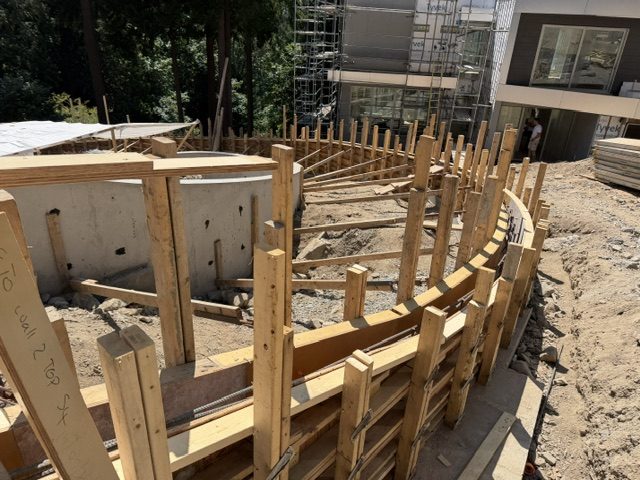
Most of this is architectural cast-in-place concrete — poured on site, shaped to your grade and finished as the surface you actually live on. On the steep, terraced lots common across North Vancouver and West Vancouver, that usually means connecting several elevations with a run of patio, a few steps and a path as one continuous surface. Terraced yards typically pair that flatwork with retaining walls — see, for example, our curved retaining walls in West Vancouver — and it is cleaner to plan the walls, steps and patio together.
Finish options that suit the rain
The finish decides how a surface looks and, just as important here, how it grips when it is wet. On outdoor North Shore flatwork we most often specify:
- Exposed aggregate — the top layer of paste is washed off to reveal the stone underneath. It is the workhorse patio and pool-deck finish up here because the texture sheds water and stays grippy in the rain.
- Broom finish — a simple, economical directional texture with reliable traction; a sensible choice for walkways and utility paths.
- Sandblast — a fine, even matte texture with dependable slip resistance, and an easy match to board-formed walls.
- Board-formed edges and risers — the timber-grain look carried onto the vertical faces of a patio edge or step.
We keep a smooth steel-trowel finish off outdoor surfaces — it becomes a skating rink in wet weather. For the full range of textures and how each is achieved, see our exposed concrete finishes guide, and the board-formed concrete page for the wood-grain look.
North Shore realities we build for
Flatwork fails up here for predictable reasons, and every one of them is preventable at pour time.
- Water has to leave. We slope every surface away from the house — roughly a quarter-inch per foot — and on wet or clay-heavy lots we tie the base into drain rock, catch basins or a perforated pipe so rain does not pond against the foundation or freeze on the patio.
- The base is the job. A properly compacted granular base carries the slab; skip it and you get settlement and cracking. On rocky sites we work down to solid bearing, and where tree roots run through the yard we deal with them before the pour, not after they lift your path.
- Control joints go where we want the crack. Concrete moves. Tooled or sawn joints at planned spacing decide where any hairline cracking lands, so it stays straight and quiet instead of wandering across the middle of your patio.
- Slip and freeze-thaw. Upper Lonsdale, the British Properties and anywhere near Grouse see genuine freeze-thaw cycles. We use an air-entrained mix, a textured finish for grip, and seal the surface so water is not sitting in the pores when it freezes.
Sealing and maintenance
Exposed aggregate and other textured finishes want a sealer, and the North Shore's rain makes that non-negotiable. A good sealer keeps water out of the pores — the single biggest defence against freeze-thaw spalling and loose stones — and deepens the colour of the aggregate. Penetrating sealers preserve the natural matte look; acrylic sealers give a richer, wet-look sheen. We will tell you which suits your surface and how it affects the grip.
Upkeep is light. Rinse or lightly pressure-wash once a year to clear the moss and organic growth that North Shore shade encourages, and reseal when water stops beading — usually every few years. One firm rule: no de-icing salt, especially the first winter. Salt attacks the cement paste around the aggregate and pops the stones loose. Use sand for traction instead.
What drives the cost
We do not quote patios off a single per-foot number, because two North Shore yards rarely cost the same to build. What actually moves the price:
- Site access and slope. A truck that can back up to the pour is cheap; wheelbarrowing or pumping concrete down to a terraced back yard is not.
- Excavation and what is underground. Breaking rock, removing tree roots or hauling out an old slab all add time before a single yard of concrete arrives.
- Drainage. Catch basins, French drains and slope correction are common here — and doing them now costs far less than repairing a heaving, failed slab in two years.
- Finish and complexity. Exposed aggregate and sandblast take more labour than a plain broom finish, and curves, integrated steps and multiple elevations all add forming work.
- Size and sealing. Larger areas use more material, and sealing adds a modest line item that protects everything above it.
When you are ready, our architectural concrete team will walk your site, talk through finishes and give you an honest read on what your lot actually needs. Reach us through the contact form.
Frequently asked questions
Is exposed aggregate slippery when it rains?
No — that is exactly why we favour it for North Shore patios and pool decks. Washing off the top paste leaves a textured stone surface that grips well in the wet, unlike a smooth trowelled finish. Sealing does not make it slick, as long as we use the right product and add a grip agent where needed.
What patio finish is best for our climate?
For traction in the rain, exposed aggregate, a broom finish or sandblast all work well; we keep smooth trowelled surfaces for indoors. The right pick depends on your look, budget and how the patio ties into walls and steps. We match the finish to how you actually use the space.
Will a concrete patio crack up here?
All concrete moves, so we place control joints to decide where any hairline cracking lands — straight, tooled lines instead of a random crack across the middle. A compacted base, correct thickness and an air-entrained mix keep it stable through our wet, freeze-thaw winters. Structural cracking is what we prevent, and repair.
How often does it need resealing?
Plan on resealing every few years, when water stops beading on the surface. Rinse or lightly pressure-wash once a year to clear the moss and organic growth North Shore shade encourages. Never use de-icing salt, especially the first winter — it loosens the aggregate. Sand gives traction without the damage.
Can you build the patio, steps and walls together?
Yes, and it is usually the better way. Terraced North Shore yards work best when the patio, stairs to grade and retaining walls are formed as one cast-in-place project, so grades, drainage and finishes line up cleanly. Ask us to plan the whole outdoor level at once rather than piece it together.
Have a project on the North Shore?
Bring us the idea or the drawings and we'll tell you honestly what it takes — with a fixed quote before any work begins.