
North & West Vancouver · Architectural Concrete
Exposed & Polished Concrete Finishes on the North Shore
Exposed concrete is concrete with nowhere to hide. There is no drywall, no tile, no paint over top — the pour and the finish are the finished surface. That is exactly why we like it, and why it rewards a contractor who pours structurally every week. Here is how we approach concrete meant to be seen on the North Shore.
Concrete you are meant to look at
Most concrete on a job site gets buried — footings under the house, a slab under flooring, a wall behind studs and drywall. Exposed concrete is the opposite: the surface you pour is the surface you live with. Every form seam, tie-hole, colour variation, and trowel mark stays visible for the life of the home, so the tolerances that a hidden pour forgives become the whole point.
We come at this as a structural contractor first — we are pouring foundations, plinths, and load paths on North Shore lots most weeks — so the concrete itself is not a novelty to us. What changes for an exposed finish is the discipline around it: the mix design, the formwork, the pour rate and vibration, the cure, and the day the forms come off. Get those right and the material does the rest. This work sits under our architectural concrete service — start there if you want to talk about a specific pour.
The range of exposed finishes
"Exposed concrete" is not one look. The finish is decided long before the concrete is placed — by how the form is built and by what happens to the surface after it cures:
- As-cast / smooth-formed — the concrete takes the texture of the form face. Phenolic-faced ply gives a tight, near-glassy wall; the crispness lives or dies on watertight forms and controlled vibration to avoid bug-holes.
- Board-formed — timber-grained walls cast against real lumber. This is a craft of its own, so we cover it in depth on its own page: board-formed concrete in North Vancouver.
- Sandblasted / acid-etched — the cured surface is abraded or etched to open up the fine aggregate for a matte, stone-like texture that also hides minor blemishes.
- Ground & polished — mechanical grinding with progressively finer diamonds, plus a densifier, to a satin-to-high-gloss floor (more on this below).
- Sealed as-is — a raw or lightly ground surface left honest and simply protected with a penetrating sealer.
Different rooms often want different finishes, and they can share one home comfortably — a polished floor, an as-cast feature wall, a sandblasted hearth.
Interior floors: ground, polished, and sealed
For interior floors the real fork is mechanically polished concrete versus grind-and-seal. Polished concrete is ground and refined with diamonds and hardened with a chemical densifier — the shine is in the slab, not a coating on top, so it wears slowly and refreshes with buffing rather than recoating. Grind-and-seal is a lighter grind finished with a topical sealer: faster and less costly up front, but the sealer is a wear layer that gets refreshed over time.
A few things we flag to North Shore homeowners before committing a floor: polished concrete pairs beautifully with in-floor radiant heat — the slab is the emitter, which answers the "isn't concrete cold?" worry — but it must be planned before the pour. And whether a slab can be polished depends on the slab you have; new pours give the most control over flatness and colour, while an existing slab has to be assessed for hardness, contamination, and cracking first. If your floors are already moving, that is a structural conversation, not a finish one — see sloping and sagging floors.
Exposed concrete outdoors: plinths, stairs, and walls
West Coast modern design loves to run concrete from inside to out — an interior floor that becomes an exterior terrace, a foundation left as a clean exposed plinth, board-formed site walls, cast stairs. Outside, the North Shore climate raises the bar: persistent rain, freeze-thaw cycling at higher elevations above Edgemont and the British Properties, and heavy runoff on steep lots. Exterior exposed concrete needs air-entrainment in the mix, deliberate drainage detailing, and a breathable sealer that sheds water without trapping it.
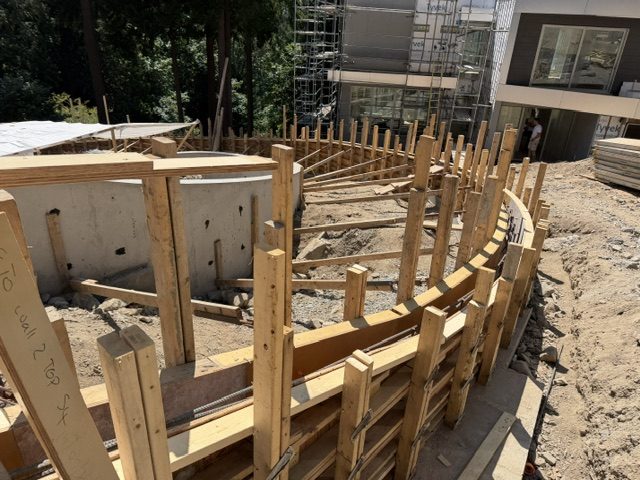
When exposed concrete is also doing structural work outdoors — holding back a slope — the finish and the engineering have to be solved together. That is its own topic: concrete retaining walls on the North Shore, and a real example in curved concrete retaining walls in West Vancouver.
Sealing and maintenance for the wet coast
Concrete is porous, and the North Shore is one of the wettest places to build in Canada, so sealing is not optional here — it is what keeps an exposed surface looking the way it did on day one. For most interior polished floors we use a penetrating densifier plus a low-sheen guard; for exteriors and feature walls, a breathable penetrating sealer that resists water and salts without leaving a plastic film.
Honest expectations matter more than a number: a mechanically polished floor is very low-maintenance — routine cleaning and the occasional buff, with major refinishing measured in many years. A topically sealed surface is refreshed more often, on a cycle set by traffic and exposure rather than a fixed date. Outdoors, expect to watch for efflorescence (the white mineral bloom that damp concrete pushes to the surface) — it is cosmetic and manageable, and the right sealer and drainage minimize it.
Designing with concrete in West Coast modern homes
Exposed concrete earns its place in West Coast modern architecture because it is a foil for everything warm and light around it — cedar soffits, big glass, blackened steel, white oak. A polished floor bounces the low winter light that North Shore homes are always chasing; an as-cast feature wall or a cast hearth gives a room a quiet structural anchor. The trick is restraint: concrete reads best as one deliberate material among a few, not everywhere at once.
Because these finishes are permanent and on display, they are worth designing in early rather than deciding on site — the pour sequence, joint layout, and colour are all easier to control before the truck arrives. We build this into custom homes and renovations across North Vancouver and West Vancouver. If you have a wall, floor, or hearth in mind, get in touch and we will talk through the finish that fits the space and the climate.
Frequently asked questions
What is the difference between polished concrete and sealed (grind-and-seal) concrete?
Polished concrete is mechanically ground with diamonds and hardened with a densifier, so the sheen is in the slab itself and wears very slowly. Grind-and-seal uses a lighter grind finished with a topical sealer sitting on top. Polishing costs more up front and lasts longer; grind-and-seal is faster and refreshed more often.
Isn't a concrete floor cold, and does it work with radiant heat?
Concrete is actually an excellent partner for in-floor radiant heat — the slab becomes the heat emitter and holds warmth evenly, which is why polished floors feel comfortable underfoot in a heated home. The key is that radiant tubing has to be planned and installed before the slab is poured, not added afterward.
Can you polish an existing concrete slab, or does it have to be a new pour?
Both are possible, but an existing slab has to be assessed first for hardness, flatness, contamination, and cracking before we can promise a finish. A new pour gives the most control over colour, flatness, and any radiant heat. If an existing floor is uneven because it is moving, that is a structural issue to solve before any polishing.
How often does exposed or polished concrete need resealing on the North Shore?
A mechanically polished interior floor is very low-maintenance — routine cleaning and occasional buffing, with major refinishing years apart. A topically sealed surface, especially outdoors in North Shore rain, is refreshed on a cycle driven by traffic and exposure rather than a fixed date. We match the sealer to the surface and tell you what upkeep to expect.
Will exposed concrete crack, since there's no flooring to cover it?
All concrete moves, and fine hairline cracking is part of the material's honesty rather than a defect. We control it with proper mix design, reinforcement, cure, and planned control joints so movement happens where it is meant to. Because the surface is on display, this planning matters more than on a hidden slab — it is exactly what pouring structurally every week teaches you.
Have a project on the North Shore?
Bring us the idea or the drawings and we'll tell you honestly what it takes — with a fixed quote before any work begins.