North & West Vancouver · Architectural Concrete
Board-Formed Concrete Walls on the North Shore
Board-formed concrete is the wall that looks like timber and stands like stone — real wood grain pressed permanently into a solid cast-in-place surface. It's a defining look of West Coast modern homes, and on the North Shore we build it as feature walls, fireplaces, facades, and retaining walls. Here's how it's made, where it fits, and what drives the cost.
What board-formed concrete actually is
Board-formed concrete is a cast-in-place wall that carries the imprint of real timber — the grain, the knots, the seams between boards — pressed permanently into its face. The wood never stays. It is the formwork: the temporary mould the concrete is poured against. When we strip the forms away, what's left is a solid concrete wall wearing the fingerprint of the boards that shaped it.
The result reads as something between raw stone and finished timber — structural, tactile, and unmistakably hand-built. It's a signature of West Coast modern architecture, and it sits naturally against the cedar, glass, and Douglas fir that define North Shore homes. For the full range of cast finishes we pour, see our architectural concrete work.
How the finish is made — the formwork is the finish
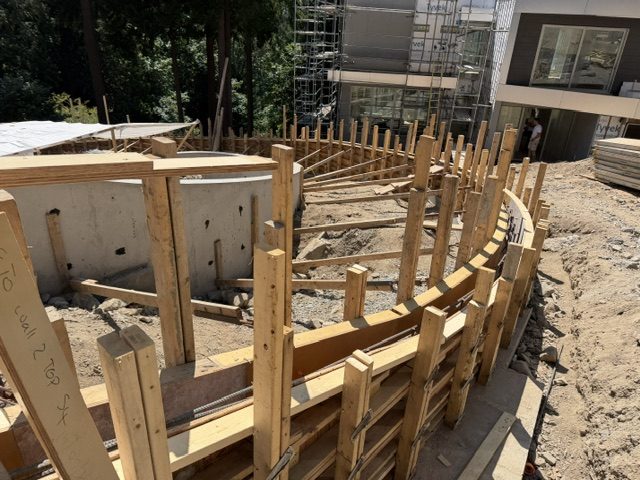
This is the part homeowners underestimate. With ordinary concrete, the forms are throwaway and the surface gets patched afterward. With board-forming there is no afterward — the face you see is the exact negative of the boards, poured in one shot. Get the formwork wrong and the wall is wrong. Get it right and there's nothing to touch up.
- Board selection and prep. We choose the timber for its grain — often rough-sawn cedar, fir, or pine — and decide how aggressively to raise or sandblast that grain so it telegraphs cleanly into the concrete.
- Form layout. Board width, orientation (horizontal is most common here), and how the seams and board ends align are all designed before a single yard of concrete is ordered.
- The pour. A consistent mix, careful vibration, and controlled placement so the concrete picks up the grain without honeycombing or blowouts at the tie points.
- Stripping and sealing. Forms come off at the right moment, and a breathable sealer protects the surface against our wet climate while letting the tone develop.
The design choices you'll make
Board-formed concrete isn't one look — it's a family of them, and the decisions are yours to make with us up front:
- Board width. Narrow boards give a fine, rhythmic line; wide boards read calmer and more monolithic.
- Grain depth. A subtly raised grain whispers; a heavily sandblasted board texture becomes the whole story.
- Orientation and pattern. Flat, aligned courses for a refined look, or offset and staggered boards for movement and shadow.
- Tone and sealing. Natural grey, or a mix adjusted warmer or cooler, then sealed matte or with a light sheen.
If you like the cast, tactile surface but want to weigh it against other options, our note on exposed concrete finishes walks through the alternatives side by side.
Where board-formed concrete shines on the North Shore
The finish earns its keep anywhere it can be seen and touched:
- Interior feature walls and fireplaces. A board-formed fireplace surround anchors an open-plan West Coast living room the way stone once did.
- Exterior facades and entries. It weathers honestly and pairs with cedar soffits and dark-framed glazing.
- Retaining walls. On our steep, rocky lots a retaining wall is often the largest structure in the yard — board-forming lets it hold back tons of soil and still look deliberate. See our North Shore retaining wall guide, and a real curved board-formed retaining wall in West Vancouver.
We build these across North Vancouver and West Vancouver — exactly the kind of steep, forested, high-rainfall sites where a wall has to be both structure and finish.
What actually drives the cost
We don't quote board-formed work off a per-foot chart, because two walls that look alike can differ enormously in effort. Honestly, the biggest driver is the formwork itself — it takes far longer to build than a throwaway form, and because there's one shot at the finish, we build it to a higher standard. What moves your number:
- Wall size, height, and geometry. Curves, corners, and tall pours all add form complexity.
- Board spec and grain treatment. Premium timber and hand-prepped grain cost more than standard rough-sawn stock.
- Structural demands. A retaining or load-bearing wall needs engineered rebar, drainage, and footings on top of the finish work.
- Access and site. Steep or tight North Shore lots slow placement and pumping.
Because the formwork is the finish, board-forming carries a genuine risk premium — a wall that doesn't come out right can mean starting over. That's exactly why it belongs with a specialist. When you're ready, tell us about your project and we'll walk the site and the design with you.
Frequently asked questions
What exactly is board-formed concrete?
It's a solid cast-in-place concrete wall poured against real timber boards, so the wood grain, knots, and seams imprint permanently into the surface. The boards are temporary formwork and get stripped away afterward. What remains is structural concrete wearing the texture of the wood that shaped it — a hallmark of West Coast modern design.
Can board-formed concrete be used on a retaining wall, not just a feature wall?
Yes, and it's one of our favourite uses on the North Shore. A retaining wall is often the biggest structure on a steep lot, and board-forming lets it hold back tons of soil while reading as a designed feature. The wall still needs engineered rebar, drainage, and proper footings underneath the finish.
Why does board-formed concrete cost more than a standard concrete wall?
Because the formwork is the finished surface, not a throwaway mould. Building forms from selected, prepped timber takes far longer, and there's one shot to get the pour right, so we build to a higher standard and carry a real risk premium. Board width, grain treatment, wall geometry, and structural demands all move the number.
Does board-formed concrete need to be sealed in our wet climate?
We recommend it. A breathable penetrating sealer helps the surface shed North Shore rain and resist staining while still letting the concrete tone develop naturally. Sealing is especially worthwhile on exterior facades and retaining walls that take direct weather. Interior feature walls and fireplaces need less protection but still benefit from a light seal.
Can you match a specific wood grain, board width, or tone?
To a large degree, yes. We choose the timber species and how much we raise or sandblast the grain, set the board width and orientation, and adjust the mix tone warmer, cooler, or standard grey. For larger jobs we'll build a sample or mock-up so you approve the look before we pour the real wall.
Have a project on the North Shore?
Bring us the idea or the drawings and we'll tell you honestly what it takes — with a fixed quote before any work begins.