North & West Vancouver · Architectural Concrete
Cast-in-Place Concrete Fireplace Surrounds & Hearths
A concrete fireplace surround is the West Coast modern answer to the old stone hearth — a single mass of material that grounds an open-plan living room. We cast ours in place on the North Shore, so the surround, hearth, and chimney wall read as one continuous element rather than a kit of applied panels.
The modern hearth: why concrete anchors an open-plan room
North Shore living rooms trend open and glassy — great rooms with floor-to-ceiling windows aimed at the water or the trees, kitchen and dining flowing into one space. That openness needs an anchor, something with visual weight to hold the room together. For decades that job went to a stacked-stone or brick hearth. In a West Coast modern home, the honest, contemporary version of that anchor is a monolithic concrete feature wall.
Concrete does what applied finishes can't: it reads as solid mass, not cladding. A single cast wall running floor-to-ceiling around a linear gas firebox becomes the fixed point the whole room organizes around — the sofa faces it, the sightlines land on it, the material carries through to the hearth and, often, out to a matching exterior wall. It's the same architectural language as our exterior concrete work, brought indoors. If you want the broader picture of what cast concrete can do in a home, start at our architectural concrete hub.
Board-formed, smooth, or exposed — choosing the finish
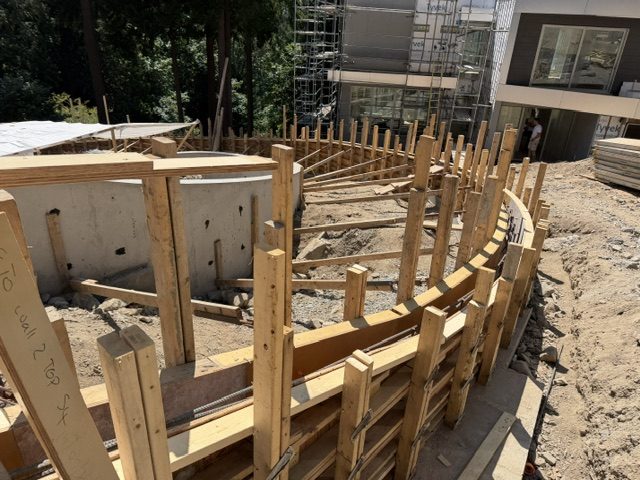
The surround's whole personality lives in its finish, and that decision is made in the formwork before a single yard of concrete is poured. The three finishes we build most often each set a different tone:
- Board-formed — real timber boards line the forms and leave their grain and plank seams cast into the face. It's the warmest of the three, giving concrete a tactile, hand-built quality that plays beautifully against warm wood floors and matte-black steel. It's also the most involved to form. We cover the method in depth on our board-formed concrete page.
- Smooth / honed — a fine, near-flat face for a minimal, gallery-like room. It shows the material at its quietest and lets the firebox and the concrete's natural colour variation carry the drama.
- Exposed aggregate — the surface is worked back to reveal the stone within the mix, adding texture and depth. See the range on our exposed concrete finishes page.
We'll bring form samples so you're choosing from real concrete faces in your own light, not a photo. On a view lot where daylight rakes hard across the wall every afternoon, that texture decision matters more than most people expect.
The technical side: clearances, the firebox, and non-combustible ratings
A fireplace surround isn't just a design object — it's an assembly built around a heat source, and it has to satisfy the BC Building Code and the firebox manufacturer's listing. This is where a lot of pretty concrete goes wrong, and where being a structural contractor rather than a decorator earns its keep.
The good news: cast concrete is non-combustible. Where a wood mantel has to hold strict setbacks from the opening — nothing combustible within six inches of the firebox, and thickness limits out to a foot — concrete can sit where combustible materials legally cannot. But non-combustible is not the same as touching the firebox. Every gas insert and firebox ships with its own listed clearances to combustibles and its own framing requirements, and we build the surround around that listing: the correct air gaps, the non-combustible substrate behind the face, and — critically — concealed service access so the unit can be maintained or replaced without demolishing the wall.
Two more things we get right that others skip. First, the hearth extension — the pad in front of the opening — has to be non-combustible all the way through, substrate included; tile laid over a wood subfloor does not qualify, but a properly built cast hearth does. Second, the surround has to integrate with the wall and chimney chase as a real building element: reinforced for this seismic zone and tied into the structure, not hung off it. A floating or cantilevered hearth in particular needs steel embedded back into the framing or the concrete wall to carry it. Where a surround ties into older or compromised structure, that's structural repair territory, and we handle both.
Finishing, sealing, and living with the surround
Once the forms come off, the face is refined — grain cleaned up on a board-formed wall, honed on a smooth one — and then sealed. Sealing a fireplace surround is a slightly different problem from sealing a countertop or a floor. Near the firebox opening we use a sealer rated for the surface temperatures the design actually produces, and we favour a breathable, penetrating sealer that lets the concrete's colour and depth show through rather than a plasticky film that can cloud or yellow with heat over time.
What you get is a surface that ages the way good concrete should — it develops a subtle patina, it shrugs off soot with a wipe, and it doesn't demand annual attention. We'll walk you through the specific sealer chosen for your wall and the light maintenance that keeps it looking right. Done properly, a concrete surround is one of the lowest-fuss feature walls in the house.
What drives the cost of a concrete fireplace surround
We don't quote fireplace surrounds off a price list, because two walls that look similar in a photo can be very different builds. Rather than guess a number, here's what actually moves the cost so you can weigh the choices honestly:
- Height and scale — a mantel-height surround is a modest pour; a floor-to-ceiling wall on a double-height North Shore great room is a much larger formwork and reinforcement job.
- Finish and formwork complexity — a smooth face is the baseline; board-forming with real timber, or working an exposed-aggregate surface, adds labour before and after the pour.
- The hearth — a hearth cast on the slab is straightforward; a floating or cantilevered hearth needs embedded steel and structural coordination.
- Firebox integration — sequencing the pour around a listed insert, building in clearances and hidden access, is more work than casting a solid wall.
- Structure and access — tying into an existing chimney or wall, seismic reinforcement, and simply getting materials into a steep, tight lot all factor in.
We serve homeowners across North Vancouver and West Vancouver. Tell us the room, the firebox you're using, and the look you're after, and we'll walk the site and give you a straight scope — get in touch.
Frequently asked questions
Can you cast a concrete surround around a gas fireplace insert?
Yes. We form the surround around the manufacturer's listed insert, following its specific clearance and framing requirements and building in concealed service access so the unit can be maintained later. Because cast concrete is non-combustible, it can sit where the listing allows — closer than a wood mantel legally could.
Won't concrete crack or get damaged from the fireplace heat?
No, when it's built right. Concrete is non-combustible and handles the surface temperatures of a properly installed insert well. We respect the firebox's listed clearances, keep the mass off the unit itself, and reinforce the wall so normal thermal movement doesn't telegraph into cracks. Direct flame contact is never part of the design.
Board-formed or smooth concrete — which suits a West Coast modern room?
Both work; it's a mood choice. Board-formed carries real wood grain and reads warmer and more hand-built, pairing well with timber and black steel. Smooth or honed reads minimal and gallery-like. We bring form samples so you decide in your own light — see our board-formed concrete page for the detail.
Do you cast in place or install precast concrete?
We cast in place, on site. That lets the surround, hearth, and chimney wall pour as one continuous, monolithic element tied into the structure — no panel seams or applied-cladding joints. It also lets us match the finish, scale, and reinforcement to your exact room rather than to a catalogue size.
Can you build a floating hearth as part of the surround?
Yes. A floating or cantilevered hearth is one of the signature moves in a modern concrete surround. It isn't just stuck on — we embed steel back into the concrete wall or the framing to carry the cantilever, and cast the hearth as a non-combustible element that meets code all the way through, substrate included.
Have a project on the North Shore?
Bring us the idea or the drawings and we'll tell you honestly what it takes — with a fixed quote before any work begins.