
Architectural Concrete
Concrete Countertops in North Vancouver
A concrete countertop isn't cut from a slab someone else quarried — it's poured for your kitchen. We cast them by hand on the North Shore, with integrated sinks, custom edges and honest patina, then finish them with sealers built to shrug off the stains and heat a real kitchen throws at them every day.
Why North Shore homeowners choose concrete
What draws people to a concrete countertop is that it isn't cut from stock — it's made for your kitchen. We can pour a single monolithic run that wraps a peninsula, drop in an integrated sink with no seam or caulk line to trap grime, and rout a set of drainboard channels right into the surface beside it. A thick waterfall end, a curved island edge, a bar top cantilevered over a base cabinet — shapes that cost a fortune to fabricate in stone are just formwork in concrete.
It's also the one countertop you can build memories into. We've cast in sea glass, river stones, fossils, brass inlays, recycled aggregate, even trivet rods set exactly where the hot pots land. If you're already planning a kitchen renovation, the counter becomes a feature rather than an off-the-shelf finish.
Cast-in-place, or cast in our shop
There are two honest ways to make a concrete countertop, and we do both.
Cast-in-place means we build the forms directly on your cabinets and pour on site. You get a truly seamless top with no joints, poured to the exact contour of the room. The trade-off is a working kitchen full of formwork and curing time, and the finishing is done overhead in your space.
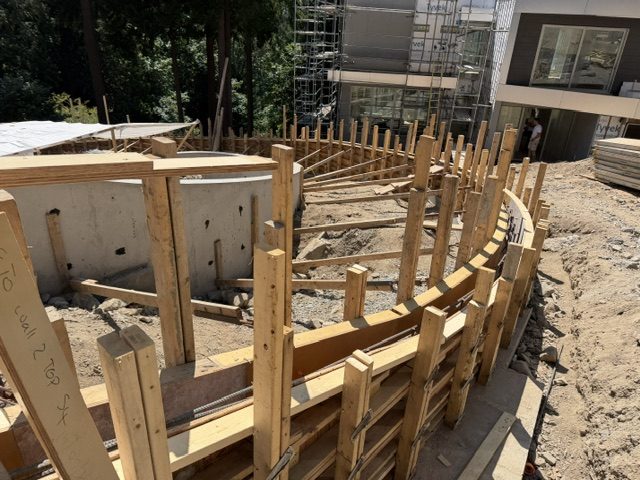
Precast in our shop means we pour each piece face-down on a machined form, cure it under controlled conditions, then grind, polish and seal it before it ever reaches your house. The finish is more repeatable and the cure is better — which matters in our damp coastal climate. The catch is weight and access: a slab can top 20 pounds per square foot, and plenty of North Vancouver and West Vancouver homes sit up steep driveways and switchback staircases. We plan piece sizes and seam placement around how we'll actually carry them in — the same discipline behind our architectural cast-in-place concrete work.
Thickness, edges, colour and finish
Standard tops land around an inch and a half to two inches thick. A chunkier apron or waterfall edge is a visual choice, not a structural one — we build a lighter core and drop the edge form to give the look of mass without the full weight. Edges can be a crisp square, a soft eased radius, a chamfer, or a hand-worn profile that reads more like carved stone.
Colour comes from integral pigment mixed through the batch, from dyes, or from acid stains that react with the cement for a mottled, variegated look. Because concrete is a built surface, we also control how much aggregate shows — from a tight, near-solid grey to a ground-and-polished, terrazzo-like face full of exposed stone. That finish is a craft of its own; see our note on exposed concrete finishes for how grinding depth changes the entire character of a piece.
Sealing, stains and heat — what to actually expect
Bare concrete is porous, so the sealer is what turns it into a countertop rather than a sponge. Modern countertop sealers have come a long way from the waxes people remember: today we use food-safe penetrating sealers, tough topical film sealers, and hybrids that combine both. A good system stands up to the everyday assault of a kitchen — red wine, coffee, lemon, tomato, olive oil — and lets you set a hot pan down without scorching.
We'll be straight with you: no countertop on earth is bulletproof, concrete included. A topical sealer resists etching from acids far better than the raw concrete beneath it, but lemon juice left in a puddle overnight can still leave a mark, and sealers wear fastest at the sink and prep zones. Most tops want a periodic light re-coat or wax refresh, and we'll show you exactly how to do it in a few minutes. Treated like a good cutting board rather than a bank vault, a concrete top ages beautifully.
Concrete vs. granite and quartz: an honest comparison
We'd rather you go in clear-eyed than call us disappointed later. Against quartz, concrete loses on pure low-maintenance: quartz is non-porous and never needs sealing, while concrete asks for occasional care. Against granite, both are natural, sealable and heat-tolerant, but granite arrives as a finished slab with a pattern you can see before you buy.
Where concrete wins is character and customization — the integrated sinks, the seamless one-piece pours, the embeds, the colours you'll never find in a slab yard. The honest cons: hairline cracks are normal in concrete. They come from curing and seasonal movement, they're almost always cosmetic rather than structural (we reinforce every top with steel mesh or fibre), and many owners grow to love them as part of the material's patina. If you need a flawless, uniform, zero-thought surface, quartz is the smarter buy — and we'll say so. If you want a handmade surface with a story, concrete is hard to beat.
What drives the cost
We don't quote countertops off a flat price-per-foot chart, because two kitchens of the same size can differ wildly in the work involved. The real cost drivers are:
- Square footage and layout — total area, plus how many separate pieces and seams the run requires.
- Thickness and edge detail — heavier profiles and hand-worked edges add form-building and finishing time.
- Sinks and cutouts — an integrated cast sink or a routed drainboard is far more labour than a simple drop-in hole.
- Embeds and custom colour — inlays, exposed aggregate and multi-step stains are all hand work.
- Cast-in-place vs. precast — on-site pours and difficult access on steep lots change the labour picture.
- Finish level — a lightly ground matte surface is quicker than a deep, high polish.
Tell us what you're picturing, we'll walk your kitchen, talk through the trade-offs honestly, and give you a real number. Start with a conversation about your project.
Frequently asked questions
Do concrete countertops crack?
Fine hairline cracks are normal in concrete and usually show up as the piece cures and moves with the seasons. We reinforce every top with steel mesh or fibre, so those lines are almost always cosmetic rather than structural, and many homeowners consider them part of the material's character. A properly built and supported top will not fail.
Can I put a hot pan on a concrete countertop, and does it stain?
A properly sealed concrete top handles hot pots well — better than many surfaces. Staining is the real watch-item: bare concrete is porous, so the sealer does the protecting. Wipe up wine, coffee, lemon and oil promptly and it resists them; leave acidic liquids sitting overnight and you can still get a mark.
How often do concrete countertops need resealing?
It depends on the sealer system and how hard the kitchen is used. Penetrating and hybrid sealers can go a long time, while sink and prep zones wear fastest. Most tops benefit from a periodic light re-coat or wax refresh — a simple job we'll teach you to do yourself in just a few minutes.
Should I choose cast-in-place or precast?
Cast-in-place gives a truly seamless top poured to your exact room, but fills the kitchen with formwork while it cures on site. Precast in our shop gives better cure control and a more repeatable finish, but means planning piece size and seams around getting heavy slabs up North Shore driveways and stairs. We'll recommend the right one for your home.
Are concrete countertops more expensive than granite or quartz?
They can be, because each one is handmade rather than cut from a slab. Cost tracks the work involved — area, thickness, edges, integrated sinks, embeds, colour and finish — not a flat per-foot rate. A simple grey top is competitive; a heavily customized, deeply polished piece with a cast sink costs more. We price your actual design.
Have a project on the North Shore?
Bring us the idea or the drawings and we'll tell you honestly what it takes — with a fixed quote before any work begins.